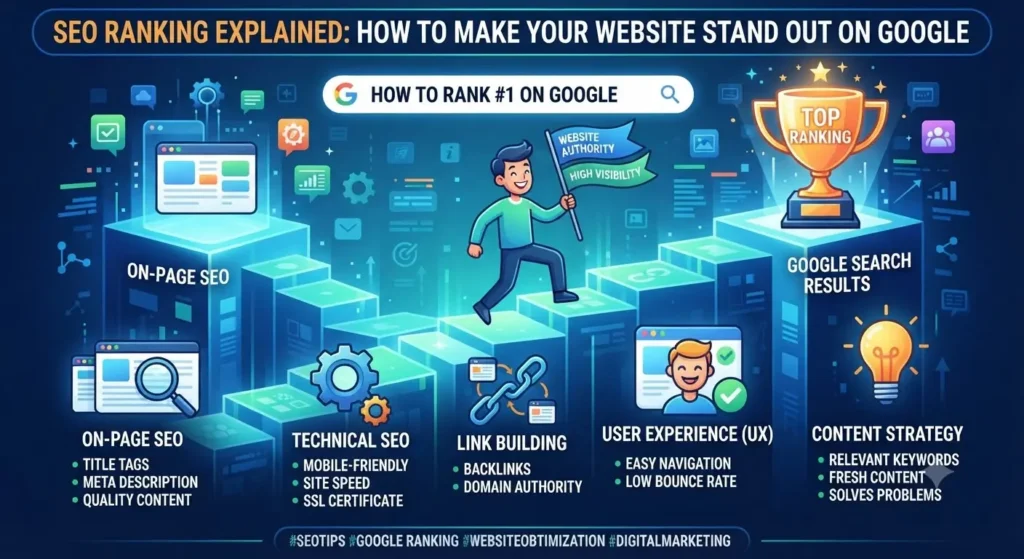
Getting your website noticed online is not always easy. You may spend hours designing your website, publishing content and improving its appearance, but what happens if people cannot find it on Google?
This is a common problem for many website owners and businesses. Having a website is important, but making sure the right audience can discover it is what really matters.
This is where Search Engine Optimization (SEO) comes in.
SEO helps websites improve their visibility in organic search results and attract people who are genuinely interested in their content, products or services. However, getting a good position on Google takes more than simply adding keywords to a page. It requires useful content, a good website experience and consistent effort.
Let’s understand how SEO ranking works and what you can do to improve your website’s visibility.
Understanding SEO Ranking
SEO ranking refers to the position of a webpage in search engine results for a particular search query.
For example, when someone searches for a digital marketing service on Google, several websites appear in the results. Some appear on the first page, while others may be listed further down.
Websites that appear higher in organic search results generally have a better opportunity to attract visitors.
Google considers different factors when deciding which pages to show, including content relevance, quality, usability and overall page experience. There is no guaranteed shortcut to the first position. Improving SEO takes time, regular monitoring and continuous improvement.
1. Start with the Right Keyword Research
Keyword research is one of the first steps in building an effective SEO strategy.
It helps you understand what people are searching for and the words they use when looking for information, products or services.
For example, someone searching for digital marketing services might use phrases such as:
- Digital marketing agency near me
- SEO services for small businesses
- How to improve website ranking
These search terms give businesses an idea of what their potential customers are looking for.
Choosing relevant keywords helps search engines understand the subject of your webpage. However, adding the same keyword repeatedly is not a good practice. Keywords should fit naturally into your content.
The main focus should always be on understanding what users want and giving them useful answers.
2. Create High-Quality and Valuable Content
Content is an important part of SEO. People visit websites because they want information, solutions or answers to their questions.
A useful blog, informative service page or detailed guide can help a website attract visitors through organic search.
Good website content should be:
- Original and informative.
- Easy to read and understand.
- Relevant to the target audience.
- Helpful in answering real questions.
- Properly organized with headings and paragraphs.
For example, if you are writing a blog about social media marketing, don’t just explain what social media marketing means. Share practical strategies, common challenges and useful ideas that readers can apply.
Think about the person reading your blog. If your content genuinely helps them, they have a better reason to spend time on your website and explore other pages.
3. Focus on On-Page SEO
On-page SEO means optimizing the content and elements of individual webpages to help search engines understand them better.
Some important on-page SEO elements include:
Title Tags
A title tag tells search engines and visitors what a webpage is about. Write clear, relevant titles that include your main topic.
Meta Descriptions
A meta description provides a short summary of a webpage. A well-written description can encourage people to click on your website in search results.
Heading Structure
Use H1, H2 and H3 headings to organize your content. A clear heading structure makes blogs easier to read and helps visitors find the information they need.
Image Optimization
Use descriptive image file names and meaningful alt text. Optimized images can also improve accessibility and help search engines understand the images.
Internal Linking
Add links to other relevant pages on your website. This helps visitors discover more information and makes website navigation easier.
These small improvements can make a difference in how people and search engines understand your website.
4. Improve Website Speed and User Experience
Imagine visiting a website that takes too long to load. Most people won’t wait for long; they will simply leave and visit another website.
This is why website speed and user experience matter.
A good website should load quickly, display information clearly and work properly on different devices.
Here are a few things website owners should focus on:
- Make the website mobile-friendly.
- Optimize large images.
- Avoid unnecessary elements that slow down pages.
- Keep navigation simple.
- Make important information easy to find.
- Pay attention to Google’s Core Web Vitals.
Core Web Vitals measure important aspects of website experience, including loading performance, interactivity and visual stability.
A website that is easy to use creates a better experience for visitors and supports your overall SEO efforts.
5. Build Website Authority Through Backlinks
Backlinks are links from other websites that point to your website.
For example, if another website includes a link to one of your blog posts, that link is considered a backlink.
Backlinks can help search engines discover your content and understand your website’s reputation. However, getting hundreds of random links is not the goal. Quality and relevance are more important than quantity.
Here are some ways to build meaningful backlinks:
- Publish useful and original content.
- Connect with relevant websites in your industry.
- Write guest articles for other websites.
- Share valuable resources that people may want to reference.
- Build genuine relationships with other content creators.
Building website authority takes time. Avoid shortcuts and artificial link-building practices that may harm your website in the long run.
6. Measure Performance and Keep Improving
SEO is not something you do once and forget. Regularly checking your website’s performance helps you understand what is working and what needs improvement.
Two useful tools for this are Google Search Console and Google Analytics.
Google Search Console
Google Search Console helps you understand how your website performs in Google Search. You can check:
- Total clicks.
- Search impressions.
- Average search position.
- Search queries.
- Website indexing issues.
Google Analytics
Google Analytics helps you understand how people interact with your website. It provides information about website visitors, traffic sources and user behaviour.
By checking these details regularly, you can identify which pages are performing well and where you need to make improvements.
Instead of making random changes, use the available data to plan your next SEO steps.
Common SEO Mistakes to Avoid
Even a well-designed website can struggle to get visibility when important SEO practices are ignored.
Some common mistakes include:
- Keyword stuffing or using keywords unnaturally.
- Publishing duplicate or low-quality content.
- Ignoring mobile optimization.
- Writing misleading page titles.
- Neglecting website speed and technical issues.
- Building irrelevant or low-quality backlinks.
- Expecting immediate results from SEO.
One thing worth remembering is that SEO takes patience. Improvements in search visibility and organic traffic may take time.
A consistent strategy based on quality content and a good user experience is more valuable than looking for quick results.
Conclusion
Getting a good SEO ranking on Google is not about finding shortcuts. It is about creating a website that people can easily discover and genuinely find useful.
From choosing the right keywords and publishing valuable content to improving website speed and building quality backlinks, every step plays a role in strengthening your SEO strategy.
For businesses, SEO creates opportunities to connect with people who are already searching for their products or services. For website owners and digital marketers, it is a way to combine creativity, technical knowledge and data to achieve better online visibility.
Google’s search environment will continue to change, but one thing remains important: understanding what people need and providing useful information.
At the end of the day, successful SEO is not just about ranking higher. It is about building a better website, reaching the right audience and creating an online presence that lasts.
Want to Improve Your Website’s Online Visibility?
Start focusing on useful content, the right SEO strategies and a better website experience. Small improvements made consistently can create meaningful results over time.
If you are interested in digital marketing, SEO and website development, explore more of my work and insights here: Freelance Digital Marketing Strategist In Kochi